 WeChat:

You Are Here:Home > Information dynamics
> Industry dynamics
NEWS CENTER
Recommended news
- What are the applications of customizing display racks in supermarkets
- Briefly introduce the wood grain transfer printing promotion table
- What is the scalability of medium-sized storage shelves
- How to reflect the product display effect of convenience store shelves
- How to do the layout of shelves in internet famous snack shops
Recommended products

Why set up small shelves in front of the checkout counter
source:jt9998.cn | Release time:2025-10-10
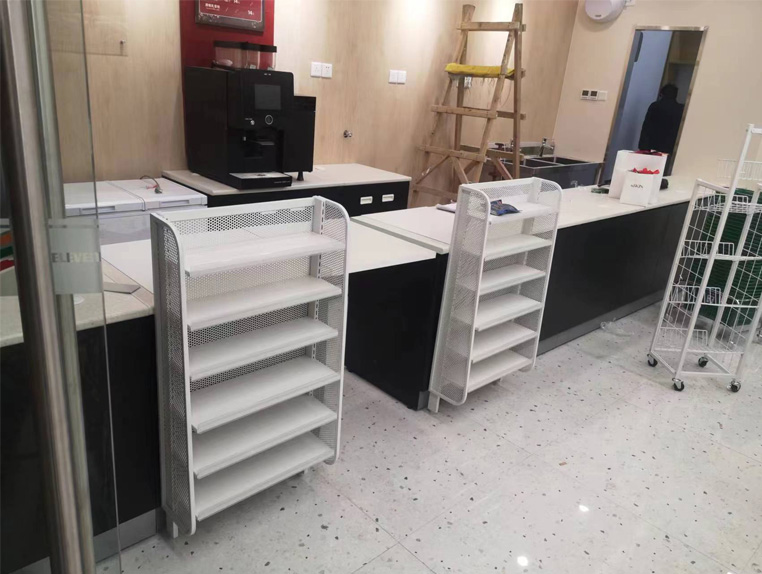
Setting up small shelves in front of the checkout counter (also known as "checkout counter shelves" or "checkout area shelves") is the core marketing and operational design of retail scenes such as supermarkets and convenience stores. The core goal is to increase the average customer price, optimize the shopping experience, and improve space utilization. Essentially, it is to utilize the consumer psychology and behavioral characteristics of "checkout waiting scenes" to achieve correct conversion. The specific reasons can be broken down into the following four points:
1. Seize the "impulse to consume" and increase the unit price per customer
When customers queue up at the checkout, they are in the "final stage of the shopping process", where the decision-making threshold for small, high-frequency, and instant products is relatively low (no need to search specifically, and prices are mostly between 10-50 yuan). Small shelves usually display "instant demand" or "impulse consumption" products such as chewing gum, mint candies, wet wipes, portable snacks (such as chocolate, small packaged potato chips), batteries, lighters, etc., which can allow customers to pick up and purchase during waiting intervals, thereby increasing additional consumption on the basis of the original shopping amount and effectively improving the average consumption amount per customer (unit price).
2. Meet "emergency needs" and optimize the shopping experience
Some customers may overlook "small essential items" during the shopping process (such as forgetting to buy tissues or needing temporary band aids), or generate new emergency needs during checkout (such as wanting to drink water while queuing or children wanting small toys). The small shelves at the checkout counter display these types of products at the "touchpoints", eliminating the need for customers to return to the shelf area to search. They can be replenished and purchased directly at checkout, solving the problem of "missing essential needs", reducing the trouble of customers traveling back and forth, and improving shopping convenience and satisfaction.
3. Utilize "idle space" to improve floor efficiency
The cashier area (especially next to the queue and on the side of the cash register) is often a "transitional space", which can easily lead to waste if not utilized. Small shelves are compact in size (mostly narrow shelves with a width of 30-50cm) and can be flexibly embedded in the gap space around the checkout counter, without occupying the core shelf area. However, they can achieve high exposure through high-frequency customer flow (almost all customers pass through the checkout counter), generating sales value for the "idle space" and improving the overall store's "floor area efficiency" (sales generated per square meter).
4. Promote "new/promotional products" to reduce promotion costs
For new products in supermarkets (such as new snacks, seasonal goods) or expiration promotional items (such as yogurt and bread that are about to expire), if placed on regular shelves, they may be overlooked due to the abundance of competing products; The small shelves at the checkout counter are the golden location for "high exposure and strong reach" - all customers will passively see them when queuing up, and small and low-priced new/promotional products are more likely to trigger trial purchases. They can quickly test the market acceptance of new products, efficiently clear inventory on time, and reduce the risk of unsold products. Compared with large-scale stacking promotion, the cost is lower and the conversion is more direct.
1. Seize the "impulse to consume" and increase the unit price per customer
When customers queue up at the checkout, they are in the "final stage of the shopping process", where the decision-making threshold for small, high-frequency, and instant products is relatively low (no need to search specifically, and prices are mostly between 10-50 yuan). Small shelves usually display "instant demand" or "impulse consumption" products such as chewing gum, mint candies, wet wipes, portable snacks (such as chocolate, small packaged potato chips), batteries, lighters, etc., which can allow customers to pick up and purchase during waiting intervals, thereby increasing additional consumption on the basis of the original shopping amount and effectively improving the average consumption amount per customer (unit price).
2. Meet "emergency needs" and optimize the shopping experience
Some customers may overlook "small essential items" during the shopping process (such as forgetting to buy tissues or needing temporary band aids), or generate new emergency needs during checkout (such as wanting to drink water while queuing or children wanting small toys). The small shelves at the checkout counter display these types of products at the "touchpoints", eliminating the need for customers to return to the shelf area to search. They can be replenished and purchased directly at checkout, solving the problem of "missing essential needs", reducing the trouble of customers traveling back and forth, and improving shopping convenience and satisfaction.
3. Utilize "idle space" to improve floor efficiency
The cashier area (especially next to the queue and on the side of the cash register) is often a "transitional space", which can easily lead to waste if not utilized. Small shelves are compact in size (mostly narrow shelves with a width of 30-50cm) and can be flexibly embedded in the gap space around the checkout counter, without occupying the core shelf area. However, they can achieve high exposure through high-frequency customer flow (almost all customers pass through the checkout counter), generating sales value for the "idle space" and improving the overall store's "floor area efficiency" (sales generated per square meter).
4. Promote "new/promotional products" to reduce promotion costs
For new products in supermarkets (such as new snacks, seasonal goods) or expiration promotional items (such as yogurt and bread that are about to expire), if placed on regular shelves, they may be overlooked due to the abundance of competing products; The small shelves at the checkout counter are the golden location for "high exposure and strong reach" - all customers will passively see them when queuing up, and small and low-priced new/promotional products are more likely to trigger trial purchases. They can quickly test the market acceptance of new products, efficiently clear inventory on time, and reduce the risk of unsold products. Compared with large-scale stacking promotion, the cost is lower and the conversion is more direct.
Previous:
Why do many people choose lightweight storage she…
Next:
What are the advantages of convenience store shel…
【Related articles】
Consultation hotline0512-52436990

- Product series
- Storage shelves
- Supermarket shelves
- Scenario display
- Supermarket shelves
- Cashier
- Wall shelf
- product display
- other parts
- product display
- Kitchen supplies
- Cleaning supplies
- Fruit and vegetable food
- Maternal and Child Home Furnishings
- About Us
- Website homepage
- About Us
- Contact Us
- News Center
- MESSAGE
 home
home
 WeChat
 telephone